
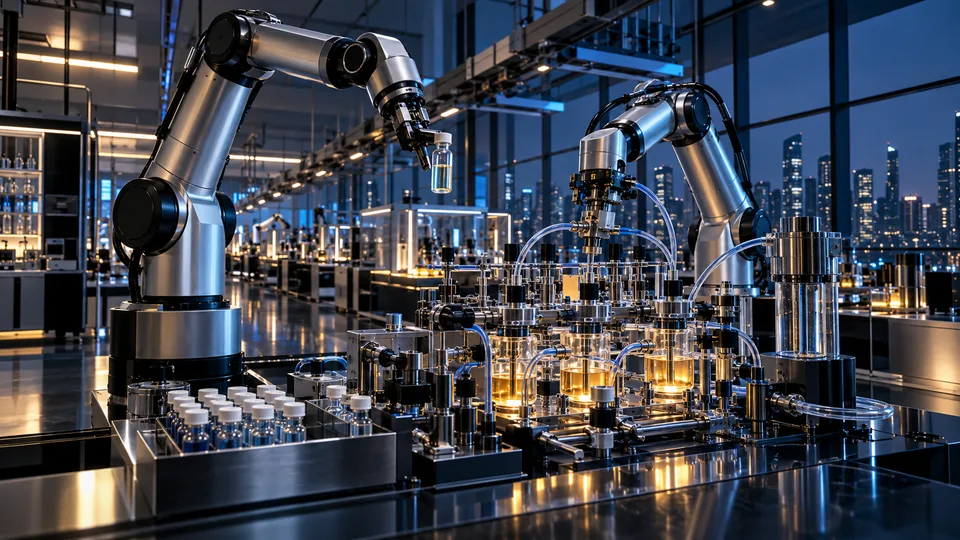
Virtual chemistry laboratory
I’ve added a virtual laboratory for AQA and OCR A. Choose a sample, add reagents, try excess and reveal the observations and equations when you’re ready. Sign in free to My Chemistry to try it. It’s brand new and I’ll keep improving it, so thanks in advance for your feedback, especially if something looks wrong or is awkward to use.
A-level chemistry practice for AQA and OCR A
Search for a topic or choose your AQA or OCR A course. You’ll find generated questions, worked feedback, practical chemistry, organic chemistry and interactive models.
Taking OxfordAQA International A-level Chemistry (9620)?
Sign in to My Chemistry and search can prioritise your AQA or OCR A course.
Questions about the site? Read the Student FAQ or ask a question →
Teaching A-level Chemistry? Teacher information and classroom use →
A-level Chemistry
A-level Chemistry
Latest additions
Periodic table explorer
Compare elements and ionisation energies, investigate Group 2 and halogens, and rotate complex-ion models. Browse the photo table, explore 118 pictures of element connections and compare allotropes. Choose AQA or OCR A, AS or A level. Beyond spec opens additional chemistry. Mystery challenges and teacher lesson routes include evidence questions and printable student sheets. Each investigation links to the existing topic practice.
Complete-answer chemistry practice
I’ve added 24 questions across polymer drawings, practical methods, structure determination, AQA time-of-flight calculations and back titration. Choose your board and course, then write or draw your answer before opening the worked answer. Check your work against the teaching points, and use My Chemistry to save your self-mark and a different question to try a few days later.
Organic reaction maps
I’ve added AQA and OCR A reaction maps, including aromatic chemistry. View or download the printable maps freely. Sign in with Google to open the interactive versions, with explanations, mechanisms and questions on each route.
Follow the mechanism
You can now work through AQA mechanisms a step at a time. Name the mechanism, then choose where the electrons move, which intermediate forms and how the reaction finishes. Some of the choices are deliberately similar, so check the atoms and charges.
Show 38 older additionsHide older additionsShowing the latest 5 additions
OCR A Mechanism Match
I've added OCR A to Mechanism Match. Choose the topics you've covered, then name mechanisms from reactions or formulae. You can spot the odd one out, race the clock and revisit questions you miss.
Organic Mechanism Match
I've added a matching game for the seven AQA organic mechanism names. Start with named reactions, switch to formulae or try an odd-one-out round. The game brings back reactions you miss.
Mark the chemistry answer
Try marking written candidate answers on bonding and equilibria. Some answers are fully correct; others miss a point or include misleading chemistry. Award marks, explain your decision and see the mark-by-mark feedback. AQA and OCR A, from Year 12 onwards.
Mixed moles and stoichiometry questions
A student asked for harder moles and stoichiometry practice. I've added mixed exam questions with unfamiliar wording, short puzzles, reverse calculations and longer problems. Choose Year 12 or full A-level, and open clues or check your working if you get stuck.
Organic Structures Practice
Five new activities using skeletal and condensed structural formulae: identify functional groups, recognise structural isomers, classify groups, match formulae and count groups. Includes Quick 10 and a classroom view.
Bond enthalpy and inorganic questions
New practice for bond enthalpy calculations, plus AQA questions on aqua ions and Period 3 oxides. Check your working, compare explanations and have another go at the skills that need it.
More organic chemistry practice
Practise benzene explanations, polymer formulae, ester reactions and OCR A mass spectra. Written answers have a checklist to help you compare your answer with the model.
More resources for Display to class
Teachers can now project the new topic questions, maths practice, electron configurations, the Haber equilibrium simulator and electrochemistry demonstrations. Choose a question, reveal a clue, then discuss the answer together.
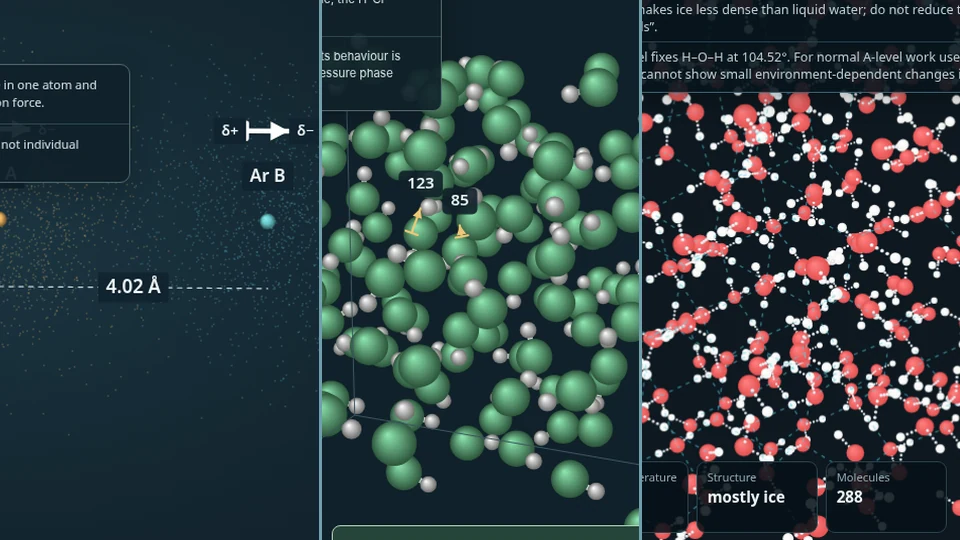
Molecular models: argon, HCl and water
Use argon to see London forces, HCl for permanent dipoles, and water for hydrogen bonding, ice and density. Each model opens in A level mode, with concise exam wording and optional deeper detail.
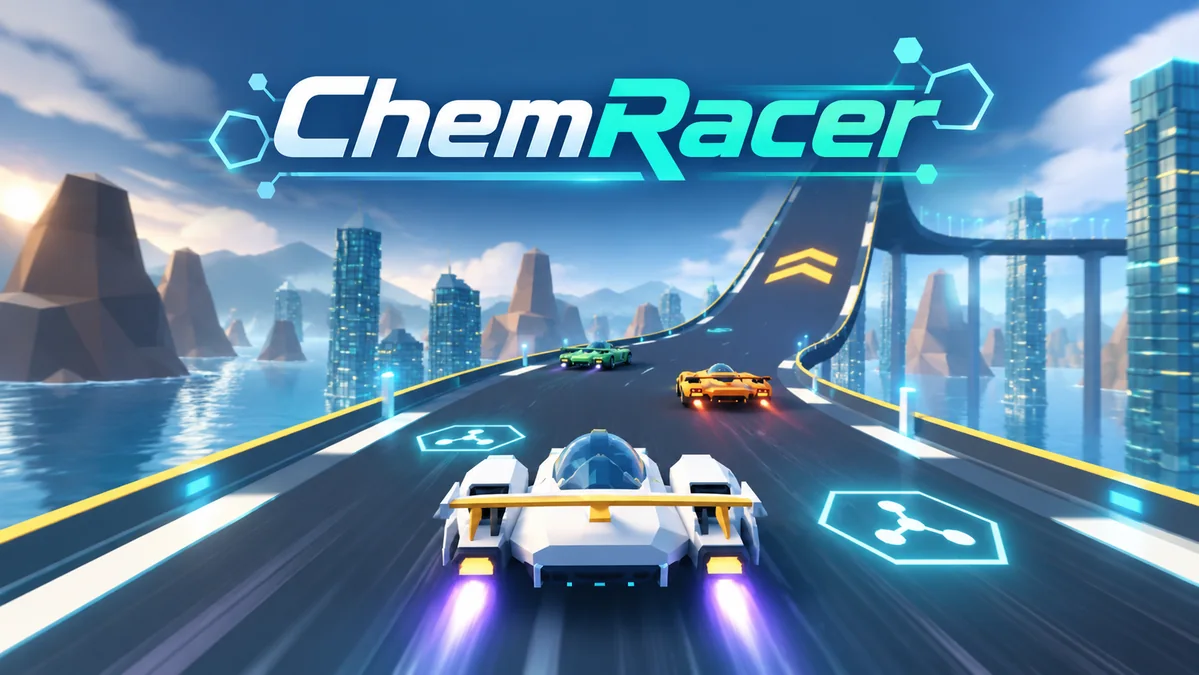
Chem Racer update
After your feedback, I've made free play a bit more forgiving, with gentler barriers and easy opening questions for new players. There's new music too, and you can keep going for extra laps to beat your best lap time.
Display to class — show your teacher
Found something useful here? Show it to your chemistry teacher. They can put it on the board and now invite your class to join with a code or QR. You can send answers to supported questions or quietly tell them you don’t get it. No names or accounts needed. You might make their day.
AQA My Chemistry — 2,926 questions
The AQA question bank has had a full review, with questions checked for chemistry, answer keys, distractors, explanations, specification coverage and diagrams. Topic and difficulty mappings have been tightened across the bank, including a separate extension level for chemistry beyond normal exam practice.
OCR A My Chemistry — 2,690 questions
The OCR A question bank has had the same full review, including PAG-linked practice. Questions have been checked for chemistry, answer keys, distractors, explanations, specification coverage and diagrams, with topic and difficulty mappings sharpened across the bank.
More moles practice
Try longer calculation chains, check your working one step at a time and get feedback on common mistakes. A four-question check helps you choose what to practise next. Teachers can project questions and share the same question with a class.
More redox titration practice
New iodometric bleach and iodate questions now sit alongside copper(II) + iodide, linked three-stage calculations, a harder two-titration chain and oxidation-state deduction from electron balance.
Rate equations & mechanisms
New AQA and OCR A rate-determining-step practice. AQA sets focus on using experimental orders to identify the controlling step; OCR A also lets you build possible mechanisms and check that the steps recover the overall reaction.
Organic nomenclature challenge
Look at a skeletal structure and type its systematic name. Choose AQA or OCR A and a topic or mixed set. Use Stretch or Beyond exam when you want harder naming.
Skeletal formula challenge
Read a skeletal structure and type its molecular formula, or work backwards from a hidden structure. Use Practice or Quick 10, add a timer, or put it on a classroom screen.
Standard form and powers of ten
Run a quick check, practise powers of ten and try EXP or ×10ˣ calculator entry. Change an exponent in the learning section to see exactly how the value changes.
Significant figures
Run a quick check or practise counting and rounding significant figures, decimal places, meaningful zeroes and choosing the right precision for a final answer.
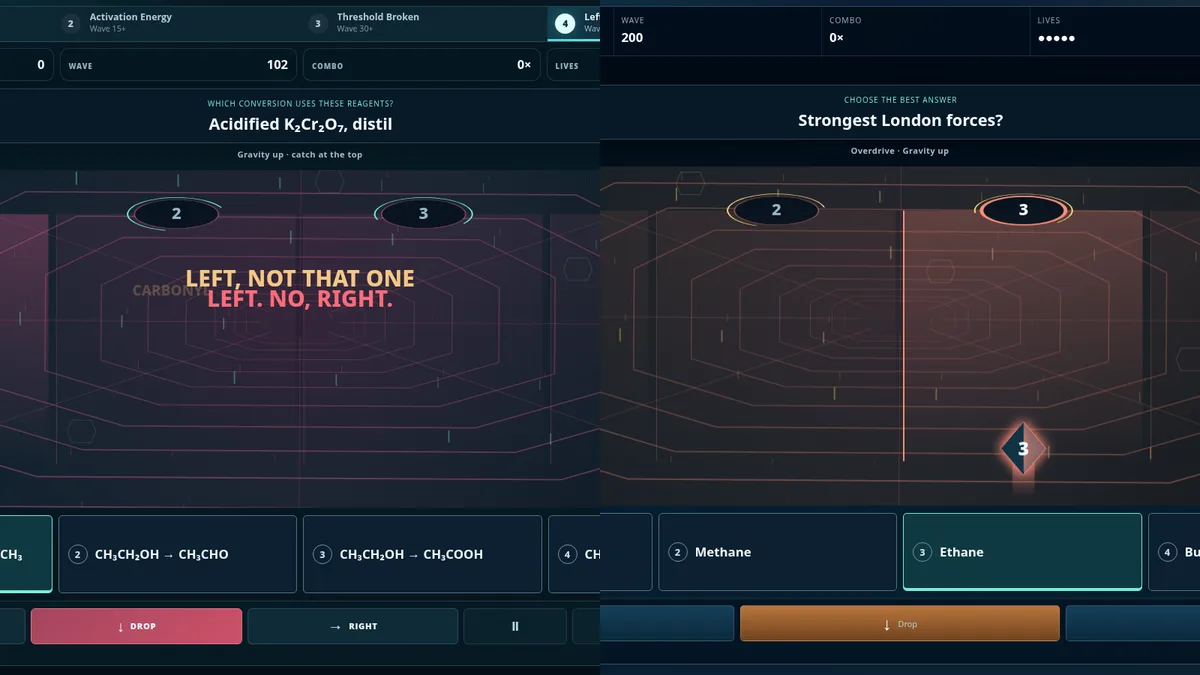
Reaction Drop + Bonding Drop: Surge Arcade
Both drop games now have rebuilt visuals, Classic or Pulse music and better phone controls. The opening waves now give you more time to read before the later stages speed up.
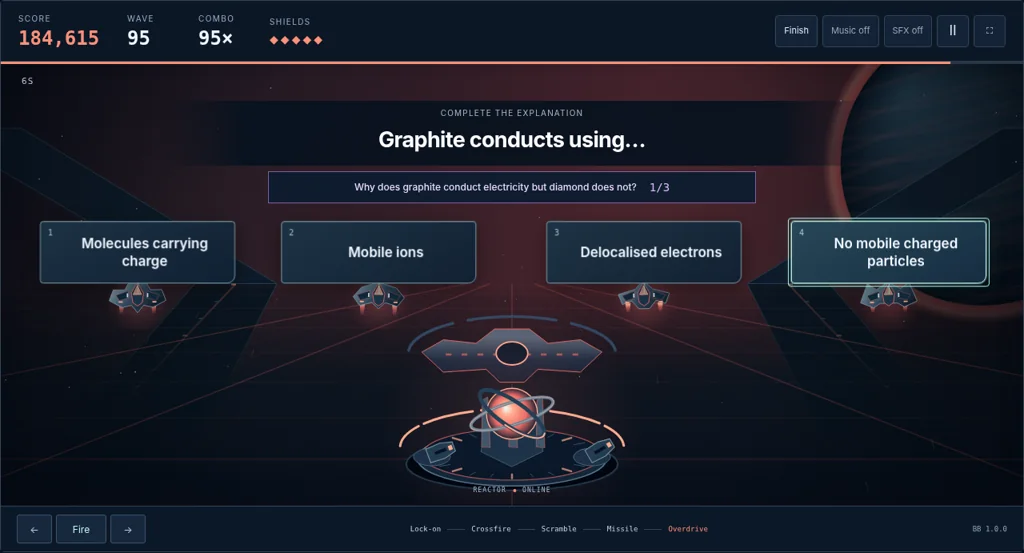
Bonding Blaster: Reactor Arcade
Defend the reactor through changing attack waves, complete linked explanations and chase a new high score. Practice mode gives you time to think.
Electron configurations + Block Count
Build atoms and ions, then use the periodic table to check configuration endings by counting across the s, p or d block.
Chem Racer: Inorganic Circuit
New green circuit for Group 2 and halogens: race through trends, uses, displacement, halide tests, bleach and water-treatment recall for AQA or OCR A.
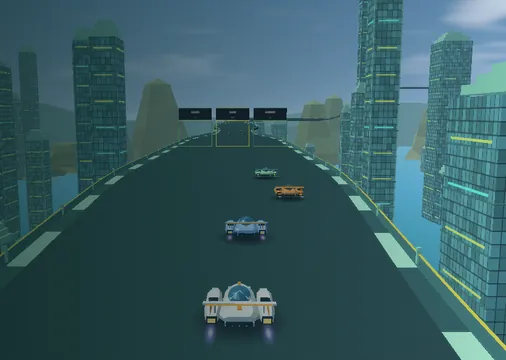
Chem Racer
A full 3D chemistry racer: steer through reagents and conditions at speed, build reaction chains, chase personal bests and enter AQA or OCR A ranked cups.
Student FAQ + ask a question
Questions about Chemistry Help, My Chemistry, sign-in and your course. If your answer isn't there, ask and check back for a reply.
Search by topic, chemistry term, common abbreviation or approximate spelling. If you're signed in, close matches from your AQA or OCR A course come first.
Organic conversion games
Choose the AQA or OCR A topics you have covered, then practise the conversions as functional groups, named compounds or structural formulae. Choose Sprint when you want to race the clock.
AQA organic synthesis
Plan routes of up to four steps, choose reagents and conditions, and practise amines, acylation and synthesis decisions without needing a drawing tool.
Amino acids, amides & chirality
AQA and OCR A practice on amino-acid acid–base chemistry, zwitterions and chirality, with OCR amides and hydrolysis where the board requires them.
Proteins, enzymes, DNA & cisplatin
AQA practice on protein structure and hydrolysis, amino-acid TLC, enzyme stereospecificity, DNA and cisplatin.
Gas chromatography & GC–MS
Retention-time and phase reasoning for AQA and OCR A, plus OCR peak proportions and calibration calculations.
Environmental organic chemistry
AQA questions on combustion and pollutants, catalytic converters, flue-gas desulfurisation, CFC photolysis and the chlorine-radical ozone cycle.
AQA Quick Revision
Work through all 498 AQA specification points in syllabus order, with tutor explanations, equations, worked examples, common mistakes and linked practice where useful.
OCR A Quick Revision
All 450 OCR A specification points across 39 topics, with concise tutor explanations, calculations, exam warnings and linked practice.
Periodicity
Full-A-level Periodicity for AQA and OCR A: trends, ionisation-energy exceptions, melting points, data and candidate-answer marking.
Group 2
Full-A-level Group 2 practice with board-specific reactions, trends, compounds, applications and synoptic calculations.
Halogens
Group 7 / 17 practice for AQA and OCR A, including displacement, redox, halide tests, observations and chlorine chemistry.
Browse by topic
Back titrationCalculation practice and worked reasoningOpen →
Moles & amount of substanceStoichiometry, gases, formulae and yieldOpen →
TitrationsCalculations, results and practical techniqueOpen →
Isotopes & mass spectrometryAᵣ, abundance, spectra and harder algebraOpen →
Structure & bondingBonding, shapes, polarity, forces and exam practiceOpen →
Ionisation energyGraphs, trends and successive ionisation energiesOpen →
Hess's lawFormation, combustion and experimental cyclesOpen →
ThermodynamicsBorn–Haber, ionic energetics, entropy and GibbsOpen →
Electrode potentialsE°cell, redox direction and electrochemical cellsOpen →
Maxwell–Boltzmann distributionsTemperature, activation energy and catalystsOpen →
NMR spectroscopyCarbon-13, proton NMR and structure deductionOpen →
Acids, bases & bufferspH, Ka, Kw and buffer calculationsOpen →
KineticsRate equations, Arrhenius and linked exam practiceOpen →
OCR A transition metalsComplexes, colours, redox and qualitative testsOpen →
Choose the kind of work you want
CalcCalculationsQuestion generators for numerical chemistryOpen →
PracticalPractical chemistryMethods, data, uncertainty and evaluationOpen →
GamesChemistry games3D Chem Racer, reaction games and fast retrieval practiceOpen →
MyMy ChemistrySpecification tracking, saved mistakes and 5,616 questionsOpen →
You can also mark a sample student answer in Periodicity. Decide what deserves credit and what needs correcting.
Not sure where to start?
If you know your board and year, use the course map above. If you know the topic, search for it. You can also use the Study Check if your revision feels busy but your marks are not moving.