
AQA 3.1.11 · OCR A 5.2.3 · RP8 / PAG8
Standard hydrogen electrode
Build the reference half-cell correctly, learn what the 0.00 V value means, and stop standard conditions becoming throwaway marks.
Keep the two circuits separate
Electrons outside; ions inside
The electrodes are connected through the external circuit, where electrons move. The half-cell solutions are connected by the salt bridge, where ions move to prevent charge building up. The bridge electrolyte must be soluble and must not react significantly with either half-cell.
Metal/metal-ion half-cell: the metal itself is the conducting electrode.
Both redox species aqueous: use an inert conductor such as Pt.
Gas half-cell: Pt provides a conducting surface in contact with the gas and solution.
Measuring E: use a high-resistance voltmeter so very little current is drawn.
Reference electrode
What 0.00 V means
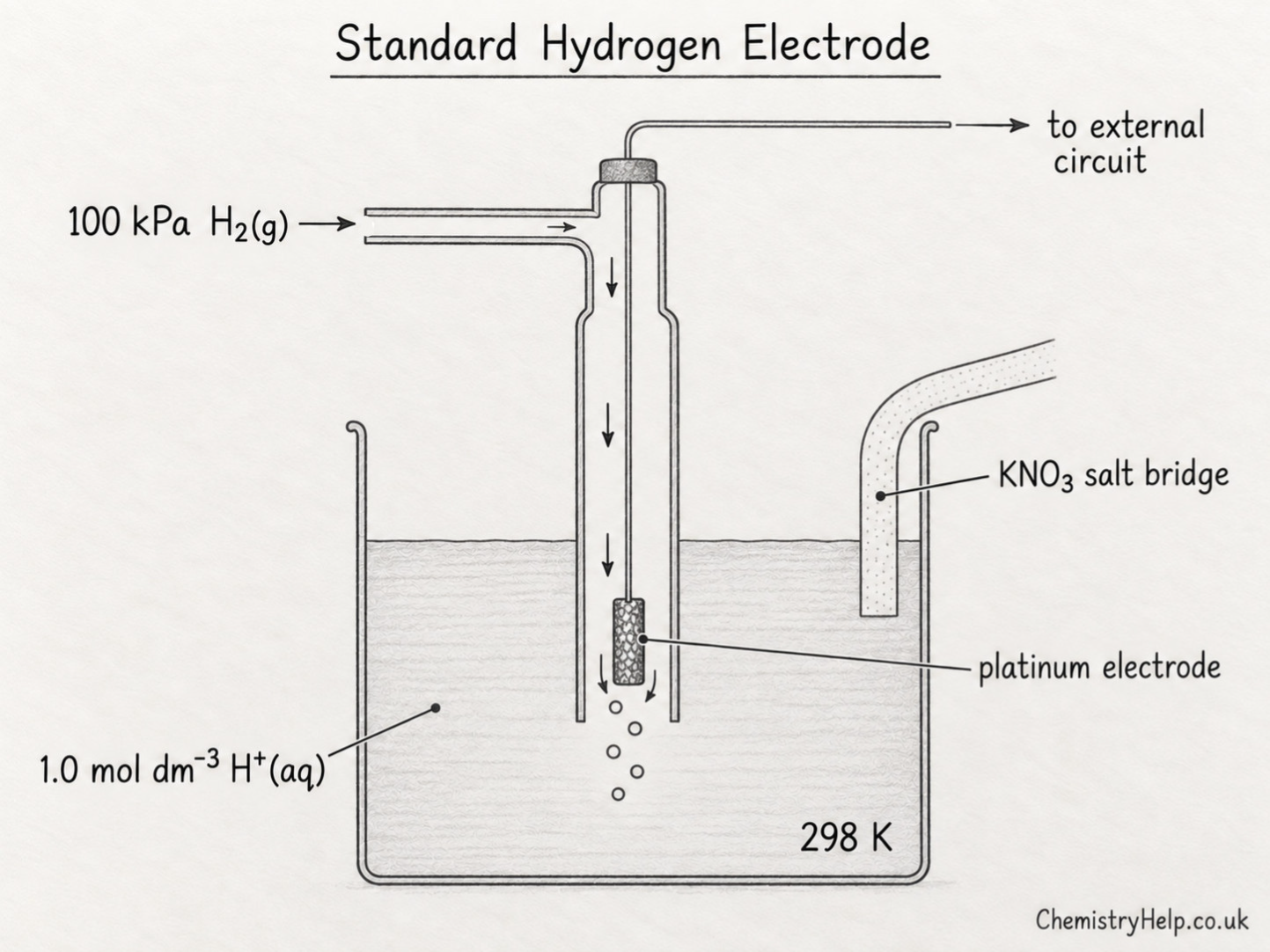
Under standard conditions, hydrogen gas is passed over a platinum electrode in contact with the hydrogen-ion solution. Platinum is an inert conductor and provides a surface for the H+/H2 equilibrium; it is not consumed.
An isolated half-cell potential cannot be measured directly: a voltmeter measures a potential difference. Standard electrode potentials are therefore measured relative to a reference.
The standard hydrogen electrode is assigned E° = 0.00 V by convention. It is the reference zero, not an absolute claim that the hydrogen half-cell has no electrical potential.