
Module 6: Organic Chemistry and Analysis · Year 13
6.2.5 Organic Synthesis
This is where the course joins up. You need the practical decisions behind making and purifying an organic product, then the reaction knowledge to move through unfamiliar functional groups and multi-stage routes without adding contradictory chemistry.
What you need to know
Open a line for a quick recap. If it feels obvious, move straight to the linked practice.
6.2.5(a)(i) Select and assemble suitable Quickfit apparatus for an organic preparation. Quick revision
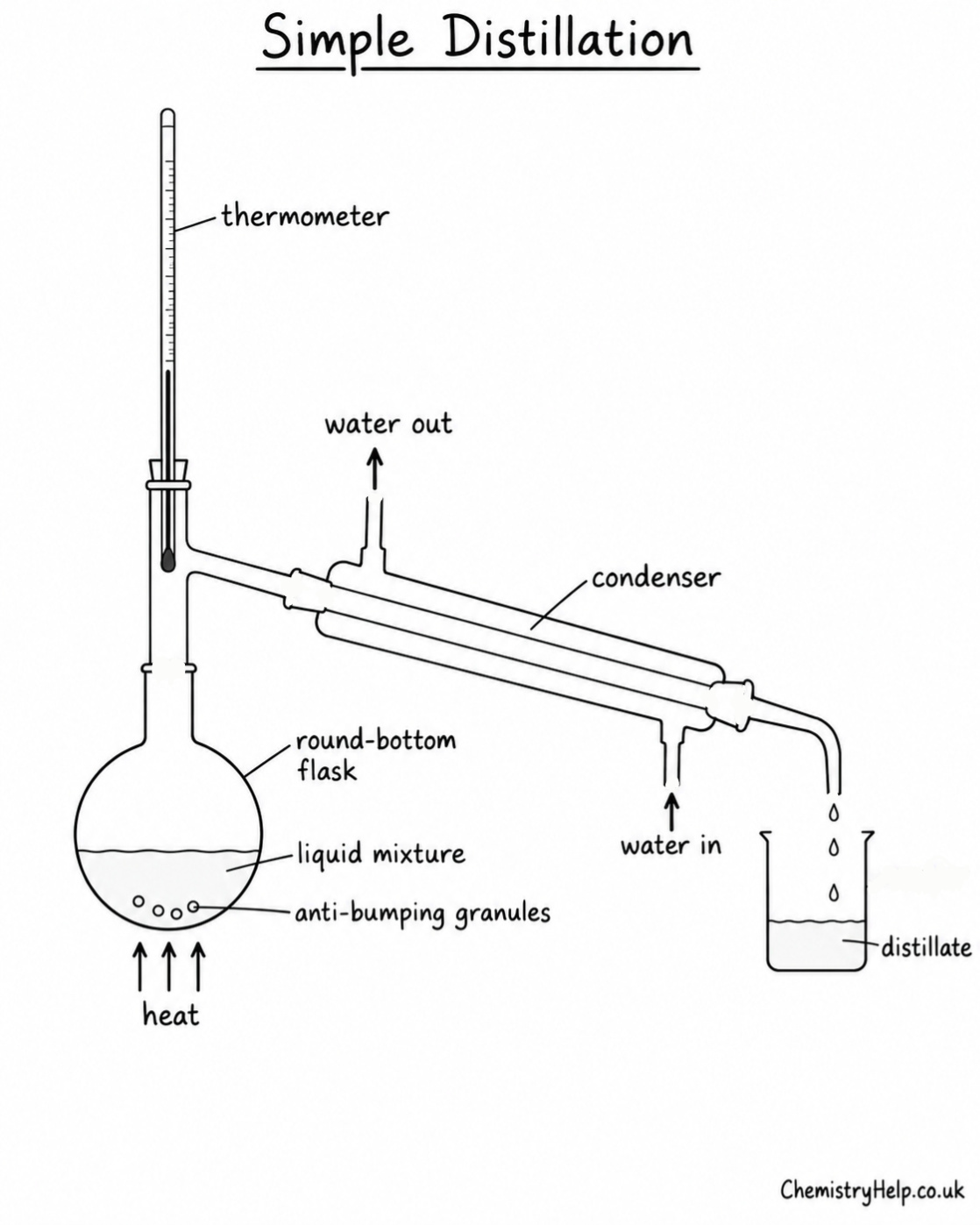
Quickfit glassware lets you connect a reaction flask, condenser and any other required pieces with ground-glass joints. Choose the arrangement for the job: a vertical condenser for reflux, or a distillation head, thermometer, condenser and receiver when you need to collect a volatile liquid.
Clamp the apparatus securely and keep a heated system open to the atmosphere. For a water condenser, cooling water enters at the bottom and leaves at the top so the jacket stays full.
6.2.5(a)(i) Explain when distillation is used during preparation or purification of an organic product. Quick revision
Distillation removes and collects a volatile component. Vapour leaves the reaction flask, condenses in the sloping condenser and is collected in a receiver.
Use it when you want the product to leave the mixture as it forms, or when a liquid product can be separated from other components by boiling point. If the aim is simply to heat the reaction mixture for a long time without losing volatile material, use reflux instead.
6.2.5(a)(i) Explain and correctly set up heating under reflux. Quick revision
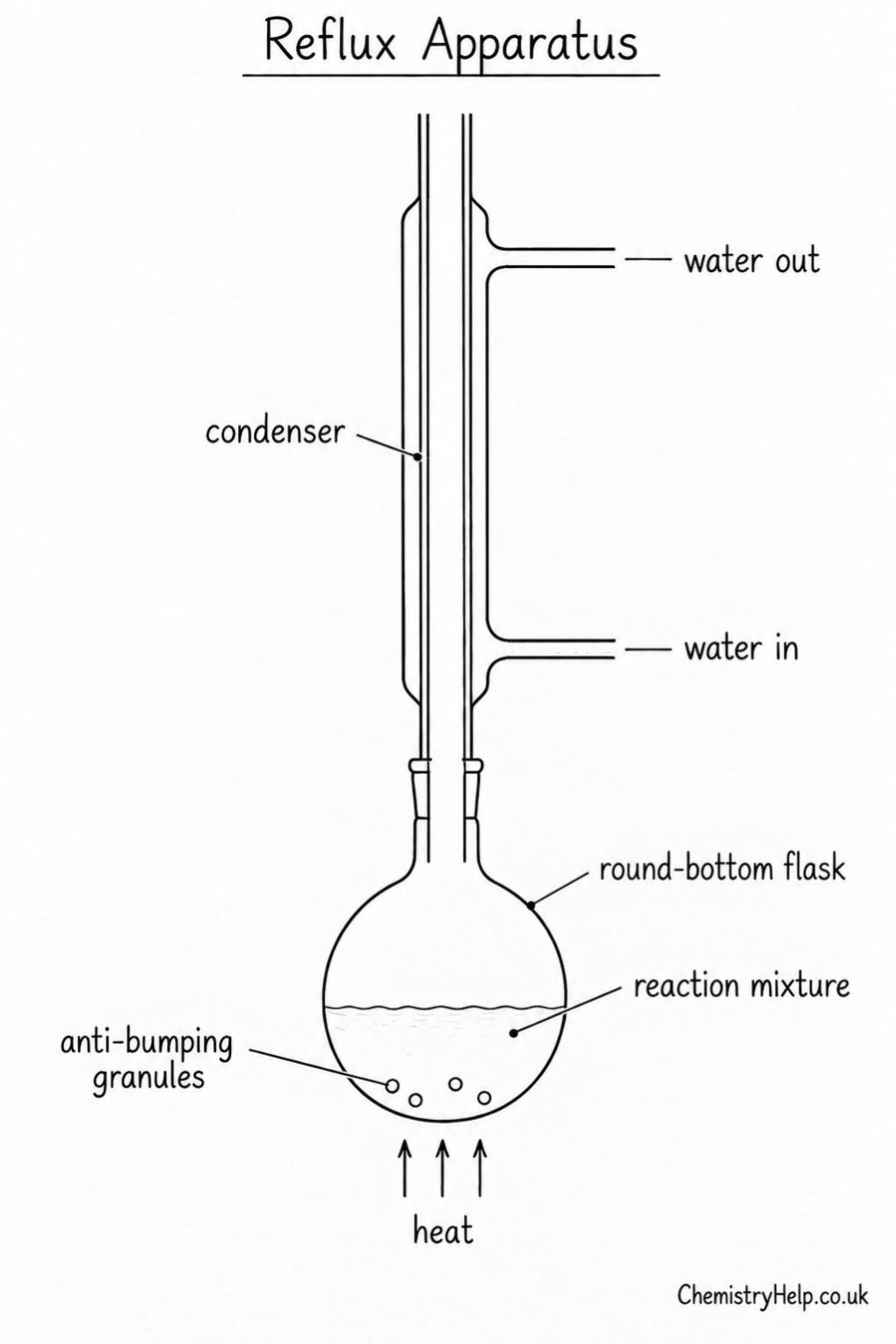
For reflux, heat the reaction mixture with a vertical water condenser attached. Vapour rises, condenses and runs back into the flask, so you can heat at the solvent’s boiling temperature for a long time without continually losing volatile reactants or solvent.
Water goes into the condenser at the bottom and out at the top. Leave the top open; sealing heated glassware can allow pressure to build.
6.2.5(a)(ii) Describe filtration under reduced pressure for isolating an organic solid. Quick revision
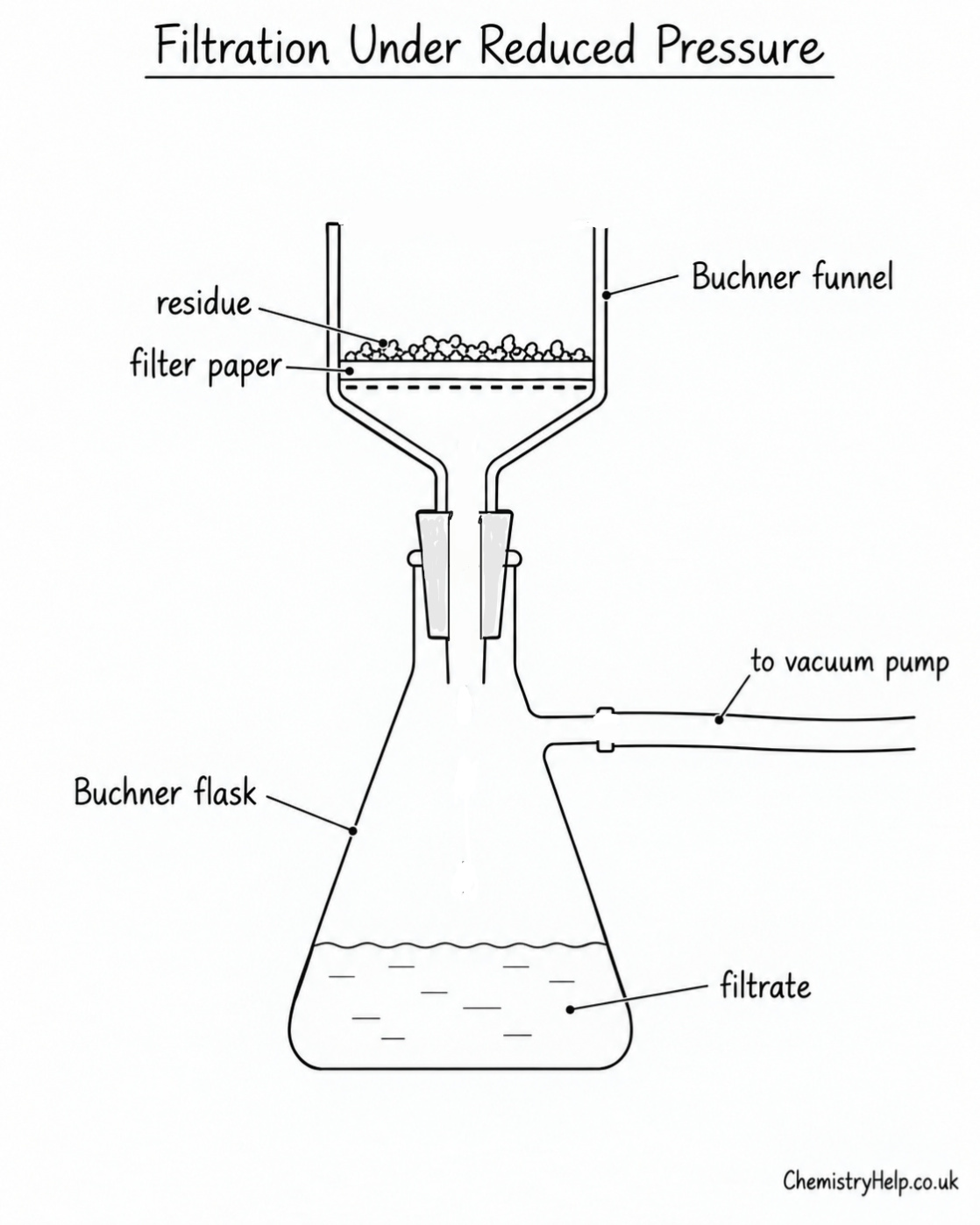
Use a Büchner funnel and side-arm flask connected to a vacuum source. Place filter paper in the funnel, wet it so it seals, then apply suction and pour in the crystal mixture.
The liquid is pulled through quickly while the solid stays on the paper. Wash the crystals with a small amount of cold solvent to remove soluble impurities without dissolving much product, then keep suction on to help dry the solid.
6.2.5(a)(ii) Describe and justify each stage of recrystallising an organic solid. Quick revision
Dissolve the impure solid in the minimum volume of hot solvent. If insoluble material is present, remove it by hot filtration. Let the solution cool so the desired compound becomes less soluble and crystallises; further cooling in ice can increase the yield.
Collect the crystals by filtration under reduced pressure, wash them with a little cold solvent and dry them. The solvent should dissolve the product well when hot but poorly when cold: that difference is what separates dissolved impurities from the crystals.
6.2.5(a)(ii) Use melting-point data to assess identity and purity of an organic solid. Quick revision
Measure the sample’s melting range and compare it with reference data. A pure solid usually melts over a narrow range close to the expected melting point.
Impurities usually lower and broaden the melting range. A close value therefore supports the proposed identity, while a narrow range supports purity; use both pieces of evidence when you judge the sample.
6.2.5(b)(i) Identify every functional group in an unfamiliar multifunctional organic molecule. Quick revision
Scan the structure systematically and name each functional group you can see. Be specific: aldehyde and ketone are different carbonyl groups; carboxylic acid, ester and amide all contain C=O but have different atoms attached to the carbonyl carbon.
Also check for amines, nitriles, phenols, aromatic rings and any earlier-course groups such as alkenes, alcohols and haloalkanes. One molecule can contain several reactive sites, so do not stop after spotting the first familiar group.
6.2.5(b)(ii) Predict which functional group reacts under given conditions in a multifunctional molecule. Quick revision
Match the reagent and conditions to the functional group they actually react with, then leave the other groups unchanged unless those conditions also affect them. This is often a selectivity question disguised as product prediction.
As a selectivity example, NaBH₄ reduces an aldehyde or ketone C=O to an alcohol, while a nitrile or ester elsewhere in the same OCR-style molecule may remain unchanged under that step. Draw the whole product so the examiner can see what reacted and what survived.
6.2.5(c) Design and interpret multi-stage routes using reactions from across the OCR course. Quick revision
Start by comparing the carbon skeleton and functional groups in the start and target structures. If the target has extra carbon atoms, locate the step that must form a C–C bond; if the carbon count is unchanged, focus on the sequence of functional-group conversions.
Working backwards from the target is often quickest. Ask which familiar reaction makes the final functional group, then repeat for the required precursor until you reach the starting material. OCR can also supply an unfamiliar reaction for you to use as part of the route.
6.2.5(c) Supply suitable reagents, conditions and structures for each stage of an organic synthesis. Quick revision
Treat every arrow as a complete mini-question: give the reagent, any condition that matters, and the correct intermediate or product structure. Solvent and heating conditions can change the chemistry, so include details such as aqueous versus ethanolic reagents, reflux, distillation or a catalyst when the route needs them.
Avoid adding spare reagents “just in case”. An extra contradictory reagent can invalidate an otherwise correct route. After drawing each intermediate, count carbon valencies and hydrogens before moving on.