
Module 4: Core Organic Chemistry · Year 12
4.2.3 Organic synthesis
Choose the right apparatus and purification sequence, then connect functional groups into short OCR Year 12 synthetic routes.
What you need to know
Open a line for a quick recap. If it feels obvious, move straight to the linked practice.
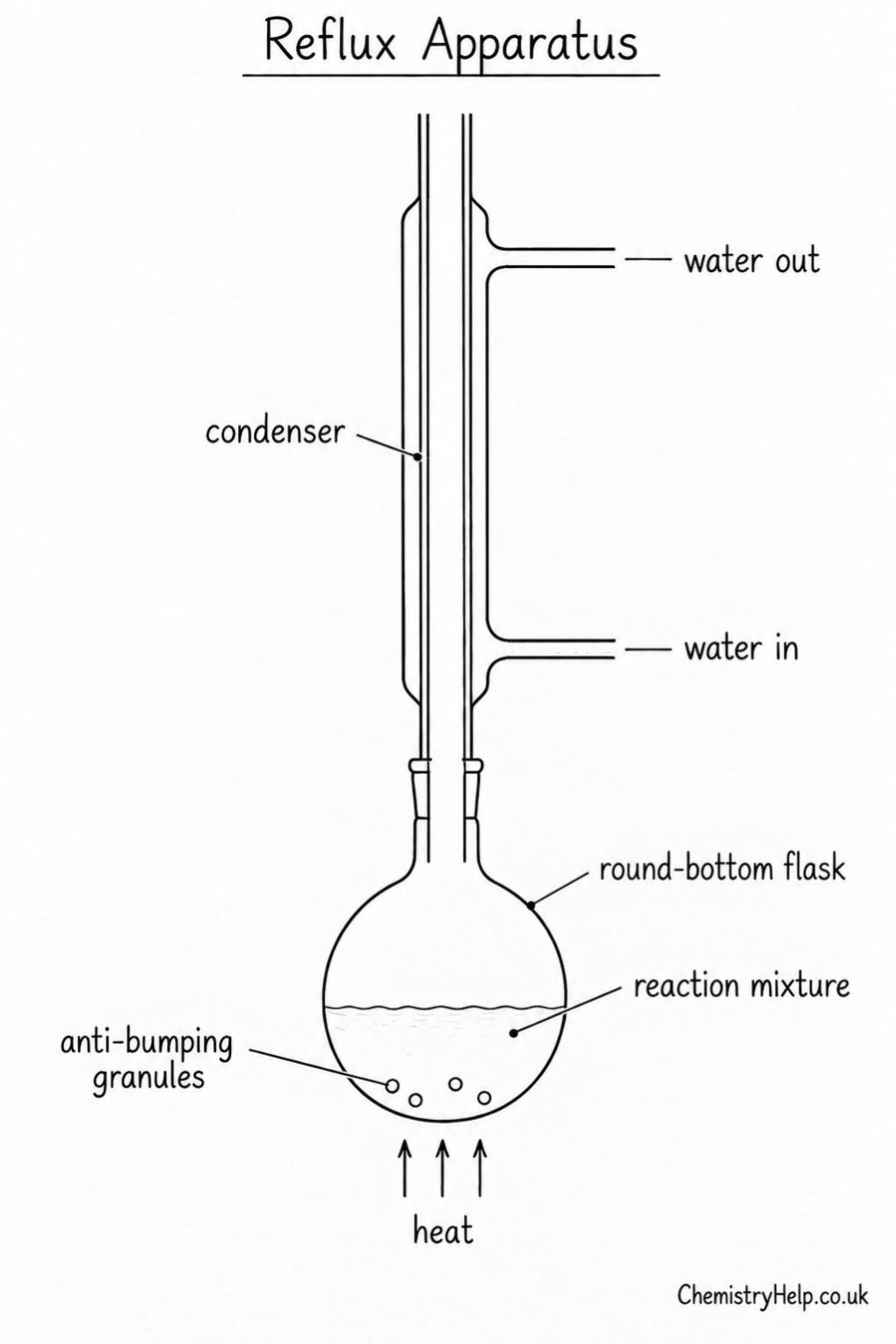
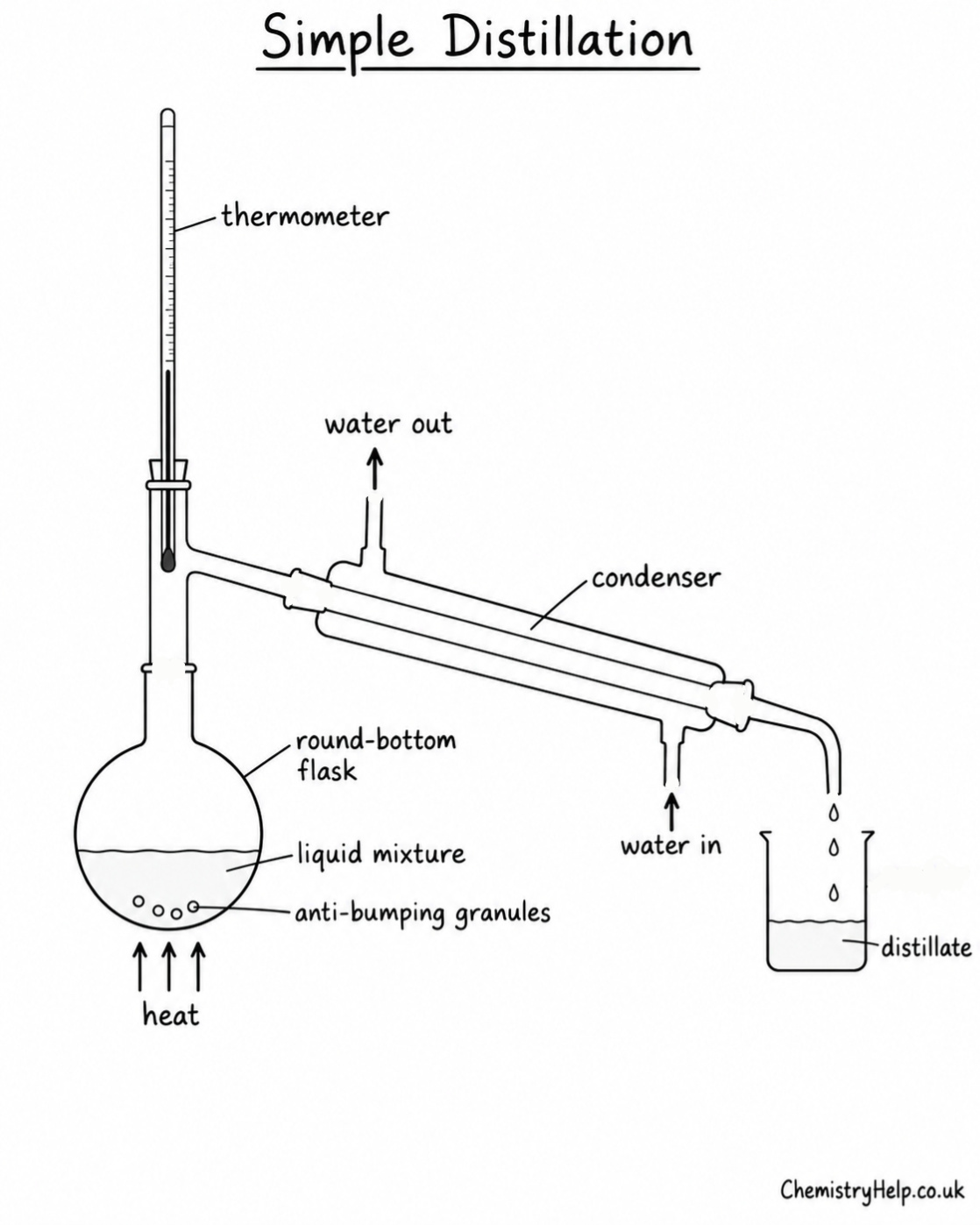
4.2.3 a(i) Describe the use of Quickfit apparatus for distillation and heating under reflux. Quick revision
Use reflux when you want to heat a reaction mixture for a long time without losing volatile material: vapour rises into a vertical condenser, condenses and runs back into the flask. The top must stay open to the atmosphere, and cooling water enters the condenser at the lower connector and leaves at the top.
Use distillation when you want to collect a volatile product as it forms or separate it by boiling point. This time the condenser carries vapour away to a receiver instead of returning condensate to the reaction flask.
4.2.3 a(ii) Plan how to make and purify a liquid organic product, using layer separation, a drying step and redistillation where appropriate. Quick revision
For a crude liquid organic product mixed with an aqueous layer, first use a separating funnel. The layers exist because the liquids are immiscible; density only tells you which layer sits on top. Run off the layers and keep the one containing your product.
Then dry the organic liquid with a suitable anhydrous drying agent, remove the solid drying agent, and redistil the liquid if you need a purer product. I would remember the OCR sequence as separate → dry → redistil.
- separating funnel: separate immiscible layers
- drying agent: remove traces of water
- redistillation: purify the liquid by boiling point
4.2.3 b(i) Identify functional groups in an organic molecule containing several functional groups. Quick revision
When you scan a structure containing several functional groups, look for the actual bonding pattern of each group, not just for individual atoms. An O atom could belong to an alcohol, ether, ester or carboxylic acid depending on what it is bonded to.
I usually mark the most distinctive features first — C=C, C=O, –OH, C–X — and then name each group from its local connectivity. One molecule can contain several functional groups at once.
4.2.3 b(ii) Predict properties and reactions of a molecule from the functional groups present. Quick revision
Once you have identified the functional groups, treat each as a clue to likely chemistry. An –OH group can hydrogen-bond and undergo alcohol reactions; C=C can undergo electrophilic addition; C–X can undergo nucleophilic substitution.
For a molecule with more than one functional group, check whether the reagent is selective for one part of the molecule. Do not assume every functional group reacts just because it is present.
4.2.3 c Devise two-stage synthetic routes using the functional group transformations covered in Module 4. Quick revision
For a two-step synthesis, compare the starting functional group with the target and ask which Year 12 conversion gets you one step closer. Then choose an intermediate that can undergo a second known reaction to reach the product.
Write the reagent and conditions above each arrow and check that you have not borrowed a Year 13 route. For example, alkane → haloalkane uses Cl₂ or Br₂ with UV, then haloalkane → alcohol uses warm aqueous hydroxide.