
Module 4: Core Organic Chemistry · Year 12
4.2.1 Alcohols
Use hydrogen bonding to explain alcohol properties, then distinguish primary, secondary and tertiary alcohols and learn their main Year 12 reactions.
What you need to know
Open a line for a quick recap. If it feels obvious, move straight to the linked practice.
4.2.1 a(i) Explain alcohol solubility and volatility compared with alkanes using polarity and hydrogen bonding. Quick revision
When you compare an alcohol with a similar-sized alkane, the big difference is the polar O–H bond. Alcohol molecules can form hydrogen bonds with one another and with water, so small alcohols are much more water-soluble than comparable alkanes and have stronger intermolecular forces.
Stronger intermolecular forces mean a higher boiling point and lower volatility than a comparable alkane. As the hydrocarbon chain gets longer, the non-polar part becomes more important, so water solubility falls.
4.2.1 a(ii) Classify alcohols as primary, secondary or tertiary. Quick revision
When you classify an alcohol, look at the carbon atom bonded directly to –OH. If that carbon is attached to one other carbon, the alcohol is primary; two other carbons makes it secondary; three makes it tertiary.
Do not count the total number of carbons in the molecule. I normally circle the C–OH carbon first and then count only its carbon neighbours.
- primary (1°): C–OH attached to 1 carbon
- secondary (2°): C–OH attached to 2 carbons
- tertiary (3°): C–OH attached to 3 carbons
4.2.1 b Write equations for combustion of alcohols. Quick revision
Complete combustion of an alcohol gives CO₂ and H₂O. Balance the carbon and hydrogen first, then finish with oxygen; remember that the alcohol molecule already contains some oxygen.
For ethanol, two carbons give 2CO₂ and six hydrogens give 3H₂O. You then need three O₂ molecules to balance the seven oxygen atoms on the product side.
4.2.1 c Predict and explain oxidation of primary, secondary and tertiary alcohols using acidified dichromate(VI), including conditions to control products. Quick revision
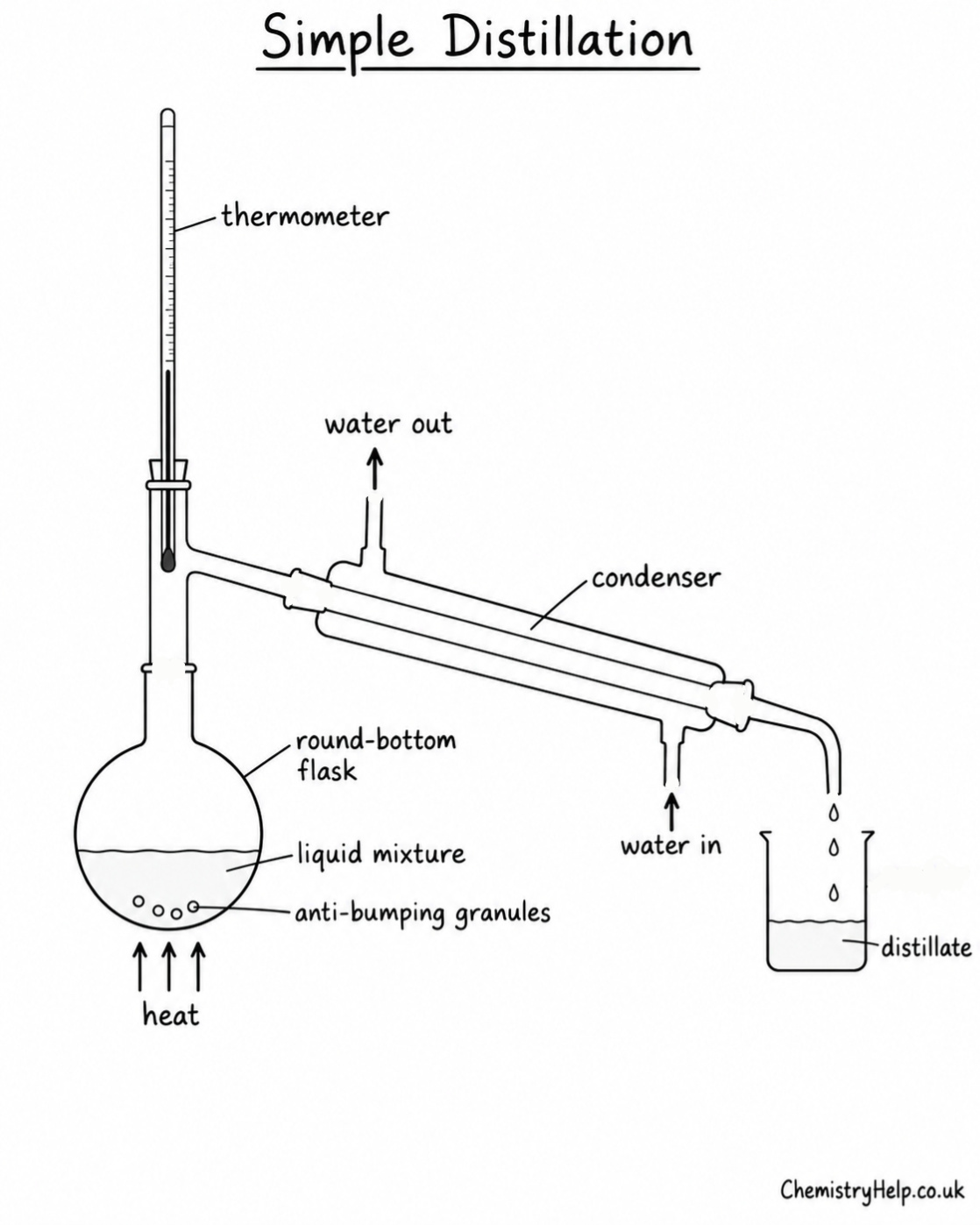
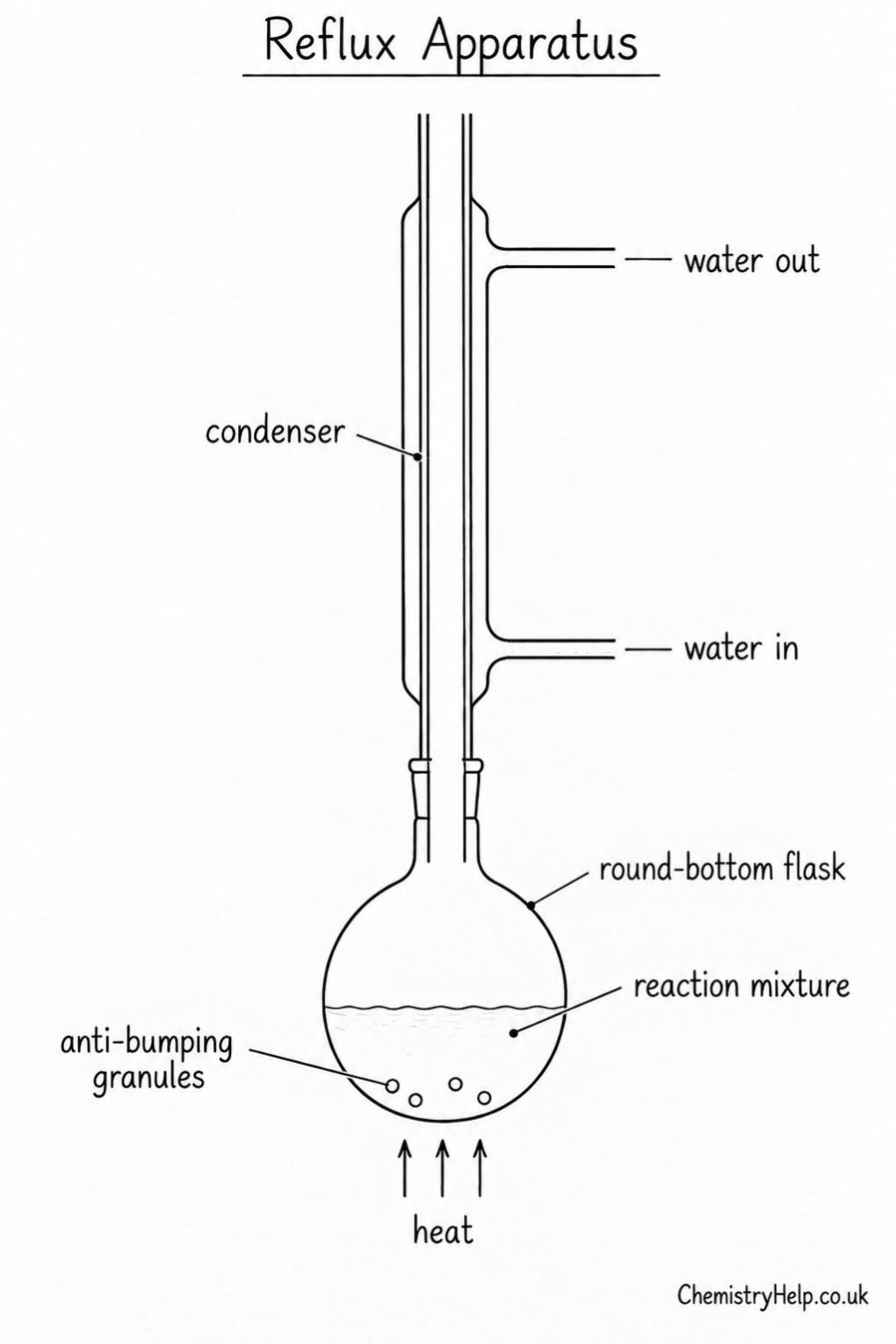
Use acidified potassium dichromate(VI) as the oxidising agent. A primary alcohol can stop at an aldehyde if you distil the product as it forms; if you heat under reflux with excess oxidising agent, further oxidation gives a carboxylic acid. A secondary alcohol gives a ketone.
A tertiary alcohol is not oxidised under these usual conditions because the carbon carrying –OH has no hydrogen that can be removed in the required oxidation. During a positive dichromate test, the colour changes from orange to green.
- 1° + acidified K₂Cr₂O₇, distil → aldehyde
- 1° + acidified K₂Cr₂O₇, reflux → carboxylic acid
- 2° + acidified K₂Cr₂O₇ → ketone
- 3° → no reaction under these conditions
4.2.1 d Write equations for dehydration/elimination of alcohols to form alkenes using acid catalyst and heat. Quick revision
Dehydrating an alcohol removes H₂O and forms a C=C bond. Heat the alcohol with concentrated H₂SO₄ or H₃PO₄ as an acid catalyst.
When you draw the product, remove –OH from the C–OH carbon and H from an adjacent carbon, then form the double bond between those two carbons. An unsymmetrical alcohol can sometimes give more than one alkene.
4.2.1 e Write equations for substitution of alcohols with halide ions in acidic conditions to form haloalkanes. Quick revision
You can replace the –OH group of an alcohol by a halogen using halide ions in acidic conditions. Match the halide to the product: for a bromoalkane use NaBr + H₂SO₄; for a chloroalkane use NaCl + H₂SO₄ (HCl is also accepted in relevant OCR mark schemes). In a named conversion, write the actual halide rather than NaX.
At the equation level, the useful pattern is alcohol → haloalkane, with the C–O bond replaced by C–X. Keep this route separate from haloalkane hydrolysis, which goes in the opposite direction using aqueous hydroxide.