Module 5: Physical Chemistry and Transition Elements · Year 13
5.1.3 Acids, Bases and Buffers
Start with Brønsted–Lowry acids and bases, then work through pH, Kₐ, Kᵥ, weak acids, buffers, titration curves, indicators and pH-meter technique.
What you need to know
Open a line for a quick recap. If it feels obvious, move straight to the linked practice.
5.1.3(a)(i) Define a Brønsted–Lowry acid as a species that donates H⁺. Quick revision
A Brønsted–Lowry acid donates a proton, H⁺. I’d learn that wording exactly because it is short and it tells you what to look for in an equation.
In an equation, follow H⁺: the acid is the species that loses the proton as the reaction goes forward.
5.1.3(a)(i) Define a Brønsted–Lowry base as a species that accepts H⁺. Quick revision
A Brønsted–Lowry base accepts a proton, H⁺. In an equation, look for the species that gains H⁺.
That definition is broader than simply calling a base an alkali. NH₃, for example, is a Brønsted–Lowry base because it accepts H⁺ to form NH₄⁺.
5.1.3(a)(ii) Identify conjugate acid–base pairs that differ by one proton. Quick revision
A conjugate acid–base pair differs by one H⁺. If you can turn one species into the other by adding or removing a single proton, you have found a conjugate pair.
For CH₃COOH ⇌ H⁺ + CH₃COO⁻, the pair is CH₃COOH/CH₃COO⁻. In NH₄⁺ ⇌ H⁺ + NH₃, it is NH₄⁺/NH₃.
5.1.3(a)(iii) Distinguish monobasic, dibasic and tribasic acids by the number of protons each molecule can donate. Quick revision
The prefix tells you how many protons one acid molecule can donate: monobasic acids can donate one H⁺, dibasic acids two, and tribasic acids three.
Do not confuse this with acid strength. “Strong” tells you how far an acid dissociates; “dibasic” tells you how many protons each molecule can donate.
- monobasic → 1 H⁺ per molecule
- dibasic → 2 H⁺ per molecule
- tribasic → 3 H⁺ per molecule
5.1.3(b) Write ionic equations showing the role of H⁺ when acids react with metals. Quick revision
When an acid reacts with a reactive metal, H⁺ is reduced to hydrogen gas. Keep the metal in the equation because it is also changing.
For magnesium, two H⁺ ions are needed to make one H₂ molecule and to balance the +2 charge on Mg²⁺.
5.1.3(b) Write ionic equations for reactions between acids and carbonates. Quick revision
I’d recognise this ionic equation on sight: carbonate ions take up H⁺ to form carbon dioxide and water.
Check the charge before you move on: 2H⁺ and CO₃²⁻ give zero overall charge on the left, matching the neutral products.
5.1.3(b) Write ionic equations for neutralisation of metal oxides by acids. Quick revision
A metal oxide reacts with H⁺ to give the metal ion and water. For a solid oxide such as MgO, keep MgO intact in the ionic equation; there are no free O²⁻ ions in the solution.
5.1.3(b) Write the ionic equation for neutralisation of an alkali by an acid. Quick revision
This is one I’d learn exactly. In a strong acid–strong alkali neutralisation, cancel the spectator ions and you are left with H⁺ reacting with OH⁻ to make water.
Before you finish, check the state symbols and the charge: +1 and −1 cancel.
5.1.3(c)(i) Construct and use the Kₐ expression for a weak acid. Quick revision
Start by writing the weak-acid dissociation: HA ⇌ H⁺ + A⁻. The acid dissociation constant, Kₐ, measures the position of this equilibrium.
Put the equilibrium concentrations of H⁺ and A⁻ on top and HA underneath. A larger Kₐ means the acid dissociates further, so it is the stronger weak acid.
5.1.3(c)(ii) Convert between Kₐ and pKₐ and use their values to compare acid strength. Quick revision
pKₐ puts Kₐ on a log scale. Use pKₐ = −log₁₀Kₐ and reverse it with Kₐ = 10⁻ᵖKₐ.
The scale runs the opposite way to Kₐ: a stronger acid has a larger Kₐ but a smaller pKₐ. That reversal is the bit worth checking before you compare two acids.
Kₐ = 1.74 × 10⁻⁵ mol dm⁻³.
- pKₐ = −log₁₀(1.74 × 10⁻⁵)
- pKₐ = 4.76
Answer pKₐ = 4.76.
5.1.3(d) Calculate pH from hydrogen-ion concentration. Quick revision
Once you know [H⁺], the pH calculation is direct. Put the hydrogen-ion concentration in mol dm⁻³ into pH = −log₁₀[H⁺].
As a quick check, a larger [H⁺] should give a lower pH.
[H⁺] = 3.20 × 10⁻³ mol dm⁻³.
- pH = −log₁₀(3.20 × 10⁻³)
- pH = 2.49
Answer pH = 2.49.
5.1.3(d) Calculate hydrogen-ion concentration from pH. Quick revision
To go back from pH to concentration, undo the logarithm: [H⁺] = 10⁻ᵖᴴ. Your answer is a concentration, so give it in mol dm⁻³.
Keep the unrounded calculator value if you need [H⁺] for another step; round at the end of the full calculation.
pH = 4.30.
- [H⁺] = 10⁻⁴·³⁰
- [H⁺] = 5.01 × 10⁻⁵ mol dm⁻³
Answer [H⁺] = 5.01 × 10⁻⁵ mol dm⁻³.
5.1.3(e) Construct and use the expression Kᵥ = [H⁺][OH⁻]. Quick revision
In any aqueous solution, [H⁺] and [OH⁻] are linked by the ionic product of water, Kᵥ. At a fixed temperature, their product has a fixed value.
At 298 K, Kᵥ = 1.00 × 10⁻¹⁴ mol² dm⁻⁶. This is the link you need when a question gives you [OH⁻] but asks for pH.
5.1.3(f)(i) Calculate pH and related quantities for strong monobasic acids. Quick revision
A strong monobasic acid fully dissociates and gives one H⁺ per acid molecule, so after any dilution or stoichiometry you can take [H⁺] as the acid concentration.
Then use the ordinary pH equation. If the question involves mixing or dilution, do that chemistry first — the logarithm is the last step.
Find the pH of 0.0250 mol dm⁻³ HCl.
- [H⁺] = 0.0250 mol dm⁻³
- pH = −log₁₀(0.0250)
- pH = 1.60
Answer pH = 1.60.
5.1.3(f)(ii) Calculate pH and related quantities for strong bases using Kᵥ. Quick revision
Start with [OH⁻] for a strong base such as NaOH. Use Kᵥ to convert [OH⁻] into [H⁺], then calculate pH.
I’d use that route because it keeps the sequence clear: [OH⁻] → [H⁺] → pH.
Find the pH of 0.0200 mol dm⁻³ NaOH at 298 K.
- [OH⁻] = 0.0200 mol dm⁻³
- [H⁺] = 1.00 × 10⁻¹⁴ ÷ 0.0200 = 5.00 × 10⁻¹³ mol dm⁻³
- pH = −log₁₀(5.00 × 10⁻¹³) = 12.30
Answer pH = 12.30.
5.1.3(g) Calculate pH, Kₐ or concentration for a weak monobasic acid using appropriate approximations. Quick revision
A weak monobasic acid only partly dissociates. If the usual approximations are valid, [HA] at equilibrium is almost the starting acid concentration and [H⁺] ≈ [A⁻].
That turns the Kₐ expression into Kₐ ≈ [H⁺]²/[HA]. From there you can find [H⁺] with a square root and then calculate pH.
A 0.100 mol dm⁻³ weak acid has Kₐ = 1.74 × 10⁻⁵ mol dm⁻³.
- [H⁺] ≈ √(1.74 × 10⁻⁵ × 0.100)
- [H⁺] = 1.32 × 10⁻³ mol dm⁻³
- pH = 2.88
Answer pH = 2.88.
5.1.3(h) Judge when the usual weak-acid approximation is invalid or inaccurate. Quick revision
After a weak-acid calculation, compare the [H⁺] you found with the starting acid concentration. The approximation assumes dissociation is small, so [H⁺] must be much smaller than [HA].
The shortcut becomes less accurate as the fraction dissociated grows. If a sizeable fraction has dissociated, [HA] at equilibrium is noticeably lower than its starting concentration. OCR can ask you to recognise that limitation, but it does not require you to solve a quadratic equation.
5.1.3(i) Define a buffer solution and describe what it does. Quick revision
A buffer solution is a system that minimises changes in pH when small amounts of acid or base are added. A buffer only copes with a limited amount, which is why “small” matters.
An OCR acidic buffer contains a weak acid and its conjugate base together: the acid removes added OH⁻ and the conjugate base removes added H⁺.
5.1.3(j)(i) Explain how mixing a weak acid with a salt of that acid forms a buffer. Quick revision
The simplest way to make an acid buffer is to mix a weak acid with a soluble salt containing its conjugate base. For ethanoic acid, CH₃COOH supplies the weak acid and CH₃COONa supplies CH₃COO⁻.
You now have both members of the conjugate pair in useful amounts: CH₃COOH can deal with added OH⁻ and CH₃COO⁻ can deal with added H⁺.
5.1.3(j)(ii) Calculate the composition of a buffer formed by partial neutralisation of a weak acid. Quick revision
You can also make a buffer by adding enough strong alkali to neutralise only some of a weak acid. Do the neutralisation in moles first. Some HA is left and some A⁻ is formed, so the final mixture contains the conjugate pair.
This is where I’d pause before using Kₐ: write down the moles of HA left and A⁻ made, then convert to concentrations if you need them.
0.0100 mol HA reacts with 0.00400 mol OH⁻.
- HA + OH⁻ → A⁻ + H₂O
- HA left = 0.0100 − 0.00400 = 0.00600 mol
- A⁻ formed = 0.00400 mol
Answer The final mixture contains 0.00600 mol HA and 0.00400 mol A⁻, so it is a buffer.
5.1.3(k) Explain how the conjugate base removes added H⁺ from an acid buffer. Quick revision
Add a small amount of acid to an acid buffer and the conjugate base, A⁻, removes most of the extra H⁺ by accepting a proton to form HA.
Because most of the added H⁺ is converted into weak acid, [H⁺] changes only a little and so does the pH.
5.1.3(k) Explain how the weak acid removes added OH⁻ from an acid buffer. Quick revision
Add a small amount of alkali and the weak acid, HA, reacts with the added OH⁻. That makes A⁻ and water.
The added OH⁻ is therefore largely removed before it can cause a large pH rise. You still have plenty of both HA and A⁻, so the buffer continues to work.
5.1.3(l) Find the pH of a buffer from Kₐ and the equilibrium concentrations of its weak-acid/conjugate-base pair. Quick revision
Use the full Kₐ expression for a buffer. Rearrange it using the weak-acid concentration [HA] and conjugate-base concentration [A⁻].
I’d write the rearrangement before putting numbers in: [H⁺] = Kₐ[HA]/[A⁻]. That makes it much harder to swap the acid and salt concentrations.
Kₐ = 1.74 × 10⁻⁵ mol dm⁻³, [HA] = 0.200 mol dm⁻³ and [A⁻] = 0.100 mol dm⁻³.
- [H⁺] = (1.74 × 10⁻⁵ × 0.200) ÷ 0.100 = 3.48 × 10⁻⁵ mol dm⁻³
- pH = −log₁₀(3.48 × 10⁻⁵)
- pH = 4.46
Answer pH = 4.46.
5.1.3(l) Calculate missing buffer concentrations, Kₐ or pKₐ from suitable data. Quick revision
The same buffer equation can be rearranged to find whatever the question has left unknown. Start by turning pH into [H⁺] if necessary, then write Kₐ = [H⁺][A⁻]/[HA] and rearrange for the missing quantity.
If the buffer was made by mixing or partial neutralisation, settle the moles first. Only then decide whether you need concentrations. If HA and A⁻ are in the same final volume, that common volume cancels in their ratio.
An ethanoic-acid buffer has Kₐ = 1.74 × 10⁻⁵, pH = 5.06 and [CH₃COOH] = 0.150 mol dm⁻³. Find [CH₃COO⁻].
- [H⁺] = 10⁻⁵·⁰⁶ = 8.71 × 10⁻⁶ mol dm⁻³.
- Kₐ = [H⁺][A⁻] ÷ [HA], so [A⁻] = Kₐ[HA] ÷ [H⁺].
- [A⁻] = (1.74 × 10⁻⁵ × 0.150) ÷ (8.71 × 10⁻⁶).
Answer [CH₃COO⁻] = 0.300 mol dm⁻³.
5.1.3(m) Explain how the carbonic acid–hydrogencarbonate system controls blood pH. Quick revision
OCR uses the H₂CO₃/HCO₃⁻ conjugate pair as the blood-buffer example. Blood plasma is normally kept at about pH 7.35–7.45.
If extra H⁺ appears, HCO₃⁻ accepts it to form H₂CO₃. If OH⁻ is added, H₂CO₃ can donate H⁺ and the OH⁻ is converted into water. In each case the buffer removes most of the added acid or base before the pH can change very far.
5.1.3(n)(i) Sketch pH curves for all four combinations of strong and weak monoprotic acids and bases. Quick revision
Start a titration-curve sketch by deciding what is in the flask and what is being added. If acid is in the flask and base is added, all four curves rise, while the starting pH, equivalence-point pH and steepness depend on the acid and base.
I’d learn these as one pattern. The acid strength affects the starting pH, and the acid/base strengths control the equivalence-point pH and how steep the change is.
- strong acid + strong base → equivalence about pH 7, very steep change
- weak acid + strong base → equivalence above pH 7, buffer region before equivalence
- strong acid + weak base → equivalence below pH 7, smaller steep region
- weak acid + weak base → no sharp vertical section
5.1.3(n)(i) Identify the acid/base combination and key regions from a pH titration curve. Quick revision
Read a pH curve in stages. The initial pH tells you about the solution in the flask, the shape before equivalence can reveal a weak acid or weak base, the steep section locates the equivalence region, and the final pH reflects excess titrant.
Do not assume equivalence means pH 7. Weak-acid/strong-base equivalence is above 7; strong-acid/weak-base equivalence is below 7.
5.1.3(n)(ii) Choose a suitable indicator by comparing its transition range with the steep section of a pH curve. Quick revision
Choose the indicator from the steep part of the titration curve around equivalence. Its transition range needs to lie inside that rapid pH change so a tiny change in added volume produces the visible colour change.
Do not choose an indicator from the starting pH of the acid or base. And for a weak-acid/weak-base titration there is no steep enough section, so OCR says no indicator is suitable.
5.1.3(n)(iii) Explain an indicator colour change using the equilibrium between its HA and A⁻ forms. Quick revision
Treat the indicator as a weak acid: HA ⇌ H⁺ + A⁻. HA and A⁻ have different colours, so changing pH changes their ratio and therefore the colour you see.
Adding acid increases [H⁺] and shifts the indicator equilibrium towards HA. Adding alkali removes H⁺ and shifts it towards A⁻. The colour change happens across a range of pH values because both forms are present during the transition.
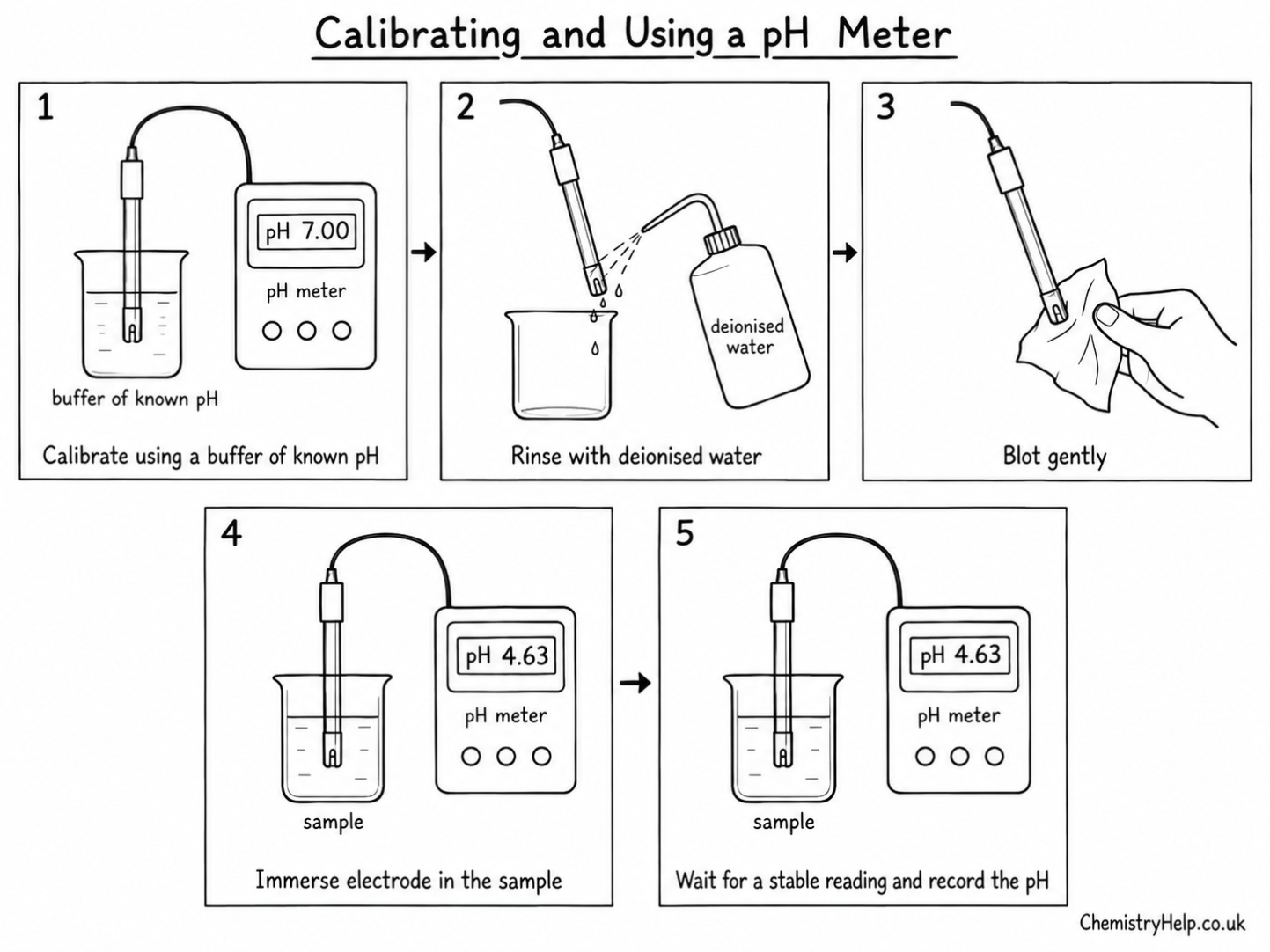
5.1.3(o) Describe how to calibrate and use a pH meter to obtain reliable measurements. Quick revision
Before you trust a pH reading, calibrate the meter with buffer solutions of known pH. Rinse the probe with distilled or deionised water between solutions so you do not carry one sample into the next, then place it in the solution and wait for a stable reading.
For a titration curve, record pH against the measured volume added. Use smaller additions through the steep region so you do not jump straight over the part of the curve you most need to locate.