
Module 2: Foundations in Chemistry · Year 12
2.1.4 Acids
Recognise the common acids and alkalis, distinguish strong from weak acids, write neutralisation equations and use accurate titration technique and calculations.
What you need to know
Open a line for a quick recap. If it feels obvious, move straight to the linked practice.
2.1.4 a(i) Know the formulae HCl, H₂SO₄, HNO₃ and CH₃COOH for the common acids named by OCR. Quick revision
OCR expects you to recognise these four acids from their names and formulae. I’d learn the name and formula as a pair, because you will need the formula again when you write salt equations.
- hydrochloric acid: HCl
- sulfuric acid: H₂SO₄
- nitric acid: HNO₃
- ethanoic acid: CH₃COOH
2.1.4 a(ii) Recall the formulae of common alkalis: NaOH, KOH and NH₃. Quick revision
The three common alkalis OCR names here are sodium hydroxide, potassium hydroxide and ammonia. You should be able to move both ways between each name and formula without having to derive it.
- sodium hydroxide: NaOH
- potassium hydroxide: KOH
- ammonia: NH₃
2.1.4 a(iii) Relate acidic aqueous behaviour to H⁺(aq) and alkaline aqueous behaviour to OH⁻(aq). Quick revision
When an aqueous solution behaves as an acid, link that behaviour to H⁺(aq). For an alkali, link it to OH⁻(aq). Those are the ions you need when you strip a neutralisation reaction down to its net ionic equation.
You do not need a long description here. If the question asks why a solution is acidic or alkaline, name the relevant aqueous ion.
2.1.4 b Explain strong and weak acids qualitatively in terms of relative dissociation. Quick revision
The strong/weak distinction is about how far the acid dissociates in water. A strong acid is essentially completely dissociated; a weak acid is only partially dissociated, so an equilibrium remains between undissociated acid molecules and ions.
This is where I want you to keep strength and concentration separate. A dilute strong acid can have a lower concentration than a concentrated weak acid; “strong” does not mean “concentrated”.
2.1.4 c(i) Write the ionic equation for neutralisation: H⁺ + OH⁻ → H₂O. Quick revision
If a strong acid reacts with a strong alkali, most of the ions are spectators. Cancel them and the chemistry comes down to H⁺(aq) reacting with OH⁻(aq) to make water.
This is one I would learn exactly. Before you move on, check the atoms and the charge: +1 and −1 cancel to give neutral H₂O.
2.1.4 c(ii) Write full equations for acids reacting with alkalis, metal oxides and carbonates to form salts. Quick revision
Start by deciding the product pattern, then use the acid to work out the salt. Hydrochloric acid gives chlorides, sulfuric acid gives sulfates, nitric acid gives nitrates and ethanoic acid gives ethanoates.
For an alkali or metal oxide you make salt + water. With a carbonate, you also make carbon dioxide. Once the formulae are right, balance the full equation.
- acid + alkali → salt + water
- acid + metal oxide → salt + water
- acid + carbonate → salt + water + carbon dioxide
2.1.4 d Describe how to prepare a standard solution and carry out an acid-base titration accurately. Quick revision
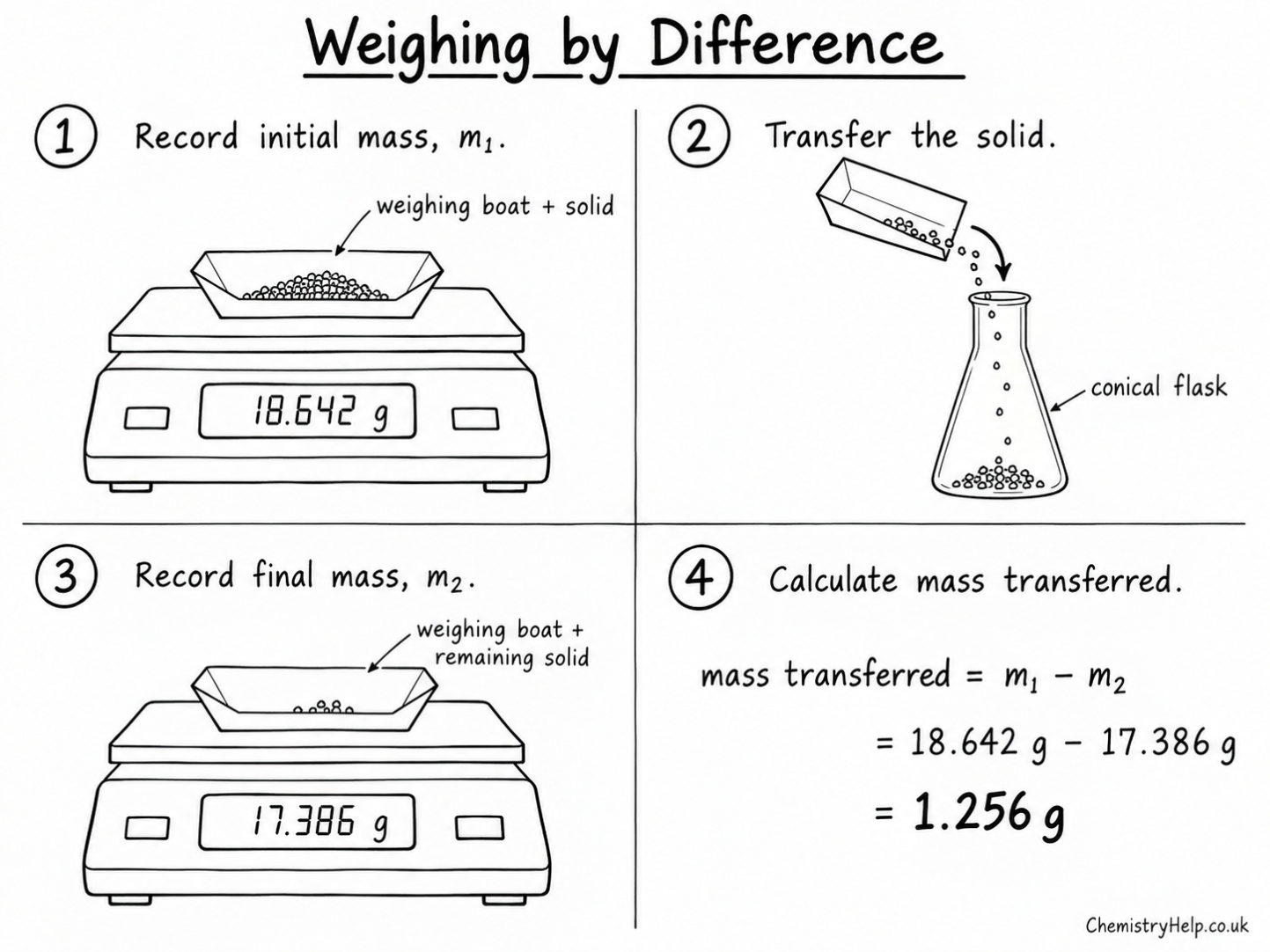
For a standard solution made from a solid, calculate the mass you need, weigh it accurately, dissolve it in a beaker, then transfer the solution quantitatively to a volumetric flask. Rinse the beaker into the flask, make up to the calibration mark with deionised water and invert the stoppered flask several times to mix.
For the titration, use a volumetric pipette for the fixed sample and a burette for the solution you deliver. Add a suitable indicator, do a rough titration, then repeat accurately and add titrant dropwise near the end point. Use concordant titres for your mean.
2.1.4 e Complete structured and unstructured titration calculations for familiar and unfamiliar acids and bases. Quick revision
A titration calculation is still a mole-ratio calculation. Find the moles of the solution whose concentration and volume you know, use the balanced equation to move to the other substance, then convert that amount into the unknown concentration, mass or other quantity.
For an unstructured question, label each number with its species as you go. OCR has criticised pages of unlabelled numbers even when the underlying chemistry was largely correct.
- find moles from the known solution
- use the reacting ratio
- convert to the requested unknown