
3.3 Organic Chemistry · Year 12
3.3.5 Alcohols
Use preparation, oxidation, elimination and combustion reactions to move between alcohols and related functional groups.
What you need to know
Open a line for a quick recap. If it feels obvious, move straight to the linked practice.
3.3.5.1 Describe industrial alcohol production by acid-catalysed hydration of alkenes. Quick revision
For industrial ethanol production, recognise hydration of ethene with steam using an acid catalyst: C₂H₄ + H₂O ⇌ C₂H₅OH. Because the reaction is reversible, the operating conditions are a compromise between equilibrium yield and rate.
Compared with fermentation, hydration uses an alkene feedstock and produces ethanol directly in a continuous industrial process. Keep the two preparation routes separate when AQA asks you to compare them.
3.3.5.1 Describe ethanol production by fermentation of glucose. Quick revision
For fermentation, remember the overall carbon balance: C₆H₁₂O₆ → 2C₂H₅OH + 2CO₂. Yeast supplies the enzymes, and the ethanol forms in aqueous solution so you need separation if you want a more concentrated product.
If you are balancing or checking the equation, one glucose molecule gives two ethanol molecules and two carbon dioxide molecules. The carbon and hydrogen counts make a quick sanity check.
3.3.5.1 Recall and justify the conditions needed for ethanol fermentation. Quick revision
When you justify fermentation conditions, connect each one to the biology. Use warm aqueous conditions for enzyme activity, avoid temperatures high enough to denature enzymes or kill the yeast, and keep oxygen out so aerobic respiration does not dominate.
The ethanol remains mixed with water, and fermentation stops being effective once the alcohol concentration becomes too high for the microorganisms/enzymes.
3.3.5.1 Explain how fermentation ethanol is separated by fractional distillation and can be used as a biofuel. Quick revision
For fermentation ethanol, you separate the ethanol-rich product from the aqueous mixture by fractional distillation because ethanol and water have different boiling behaviour. The separated ethanol can then be used as a fuel or blended into fuel.
The ethanol is a biofuel because its carbon came recently from biomass. The separation method and the environmental evaluation are separate parts of the story.
3.3.5.1 Explain what is meant by a biofuel. Quick revision
For the definition, keep it simple: a biofuel is a fuel made from recently living biological material or products derived from it. Ethanol made by fermenting plant sugars therefore counts as a biofuel.
That definition says where the feedstock came from. It does not by itself prove zero net greenhouse-gas emissions; that requires a life-cycle comparison.
3.3.5.1 Justify fermentation conditions in terms of enzyme/microorganism activity and avoiding unwanted reactions. Quick revision
Fermentation conditions follow from the biology: lower temperature slows enzyme-controlled reactions, excessive temperature damages enzymes/yeast, and oxygen encourages aerobic respiration and reduces ethanol production.
If you are asked to justify a condition, connect the condition to rate, enzyme activity or competing metabolism. Listing “warm, anaerobic” without the reason leaves the explanation unfinished.
3.3.5.1 Use equations and wider life-cycle reasoning to evaluate the claim that fermentation ethanol is carbon neutral. Quick revision
If you evaluate the claim that fermentation ethanol is carbon neutral, start with the narrow carbon cycle: growing biomass removes CO₂ by photosynthesis and burning the ethanol returns that recently fixed carbon to the atmosphere. Then widen the calculation to the whole life cycle.
A real life-cycle judgement also includes farming, fertiliser, processing, distillation, transport and land-use effects. So “renewable feedstock” is not enough evidence for zero total emissions.
3.3.5.1 Draw the acid-catalysed electrophilic-addition mechanism for forming an alcohol from an alkene and steam. Quick revision
For acid-catalysed hydration, the alkene π pair first attacks H⁺ to form the more stable carbocation where relevant. Water attacks that carbocation through an oxygen lone pair, then loss of H⁺ gives the alcohol and regenerates the acid catalyst.
Show the proton transfer that regenerates the catalyst. If H⁺ appears as a reactant but never reappears, the mechanism does not demonstrate acid catalysis.
3.3.5.1 Discuss environmental and ethical considerations that affect decisions about biofuel use. Quick revision
Compare biofuels: look beyond the tailpipe. Consider greenhouse-gas balance, land demand, competition with food production, biodiversity, water and fertiliser use, plus the energy needed for processing and transport.
The sensible conclusion depends on the feedstock and production route. A crop-derived fuel can reduce fossil-carbon use while still carrying substantial environmental costs elsewhere in its life cycle.
3.3.5.2 Classify alcohols as primary, secondary or tertiary from the carbon bearing the OH group. Quick revision
When you classify an alcohol, ignore the total carbon count and look only at the carbon bearing OH. One carbon group attached to that carbon means primary, two means secondary and three means tertiary.
Classify CH₃CH(OH)CH₂CH₃.
- look at the carbon bearing OH
- it is bonded to two other carbon atoms
Answer Butan-2-ol is a secondary alcohol.
3.3.5.2 Follow oxidation of a primary alcohol first to an aldehyde and then to a carboxylic acid. Quick revision
For a primary alcohol, keep the oxidation sequence visible: alcohol → aldehyde → carboxylic acid. Distil the aldehyde as it forms if you want to stop there; use reflux with excess oxidising agent if you want further oxidation to the acid.
3.3.5.2 Know that oxidation of a secondary alcohol gives a ketone. Quick revision
If you oxidise a secondary alcohol, you get a ketone. The carbon bearing OH stays attached to two carbon groups, so the C=O ends up within the chain.
A secondary alcohol oxidises to a ketone. Acidified dichromate(VI) changes from orange to green as Cr(VI) is reduced.
3.3.5.2 Know that tertiary alcohols resist oxidation under the conditions used for primary/secondary alcohols. Quick revision
For a tertiary alcohol, look at the carbon bearing OH and notice that it has no H attached. Under the usual acidified dichromate(VI) conditions you cannot form a carbonyl without breaking a C–C bond, so oxidation does not occur in the same way.
The absence of a hydrogen on the carbon bearing OH is the structural reason. Under these conditions there is therefore no orange-to-green dichromate(VI) change attributable to alcohol oxidation.
3.3.5.2 Recognise acidified potassium dichromate(VI) as the required oxidising reagent for these alcohol reactions. Quick revision
Use acidified potassium dichromate(VI) as the oxidising reagent for the required alcohol oxidations. A positive oxidation changes dichromate(VI) from orange to green as Cr(VI) is reduced to Cr(III).
Tertiary alcohols do not give the corresponding oxidation under these usual conditions, so the reagent observation must be interpreted alongside the alcohol structure.
3.3.5.2 Write balanced oxidation equations for alcohols, with [O] acceptable as shorthand for the oxidant. Quick revision
Using [O] shorthand keeps alcohol oxidation equations focused on the organic change. For a primary alcohol, RCH₂OH + [O] → RCHO + H₂O, followed by RCHO + [O] → RCOOH; a secondary alcohol gives a ketone.
Balance the H and O atoms as well as the carbon skeleton. [O] represents oxidising equivalents; it is not an atom or a formula for dichromate.
3.3.5.2 Explain how distillation versus reflux/continued oxidation controls whether a primary alcohol gives aldehyde or carboxylic acid. Quick revision
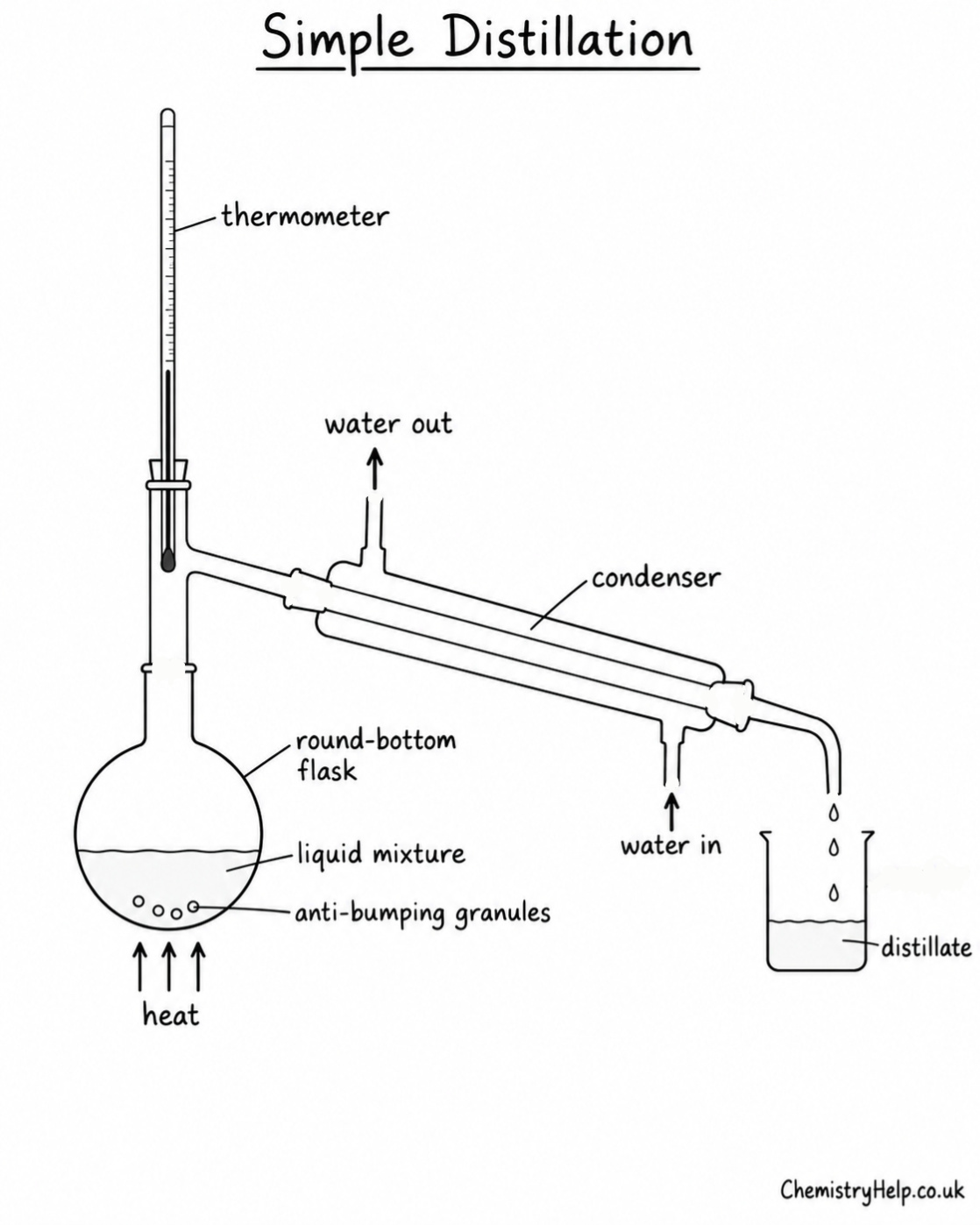
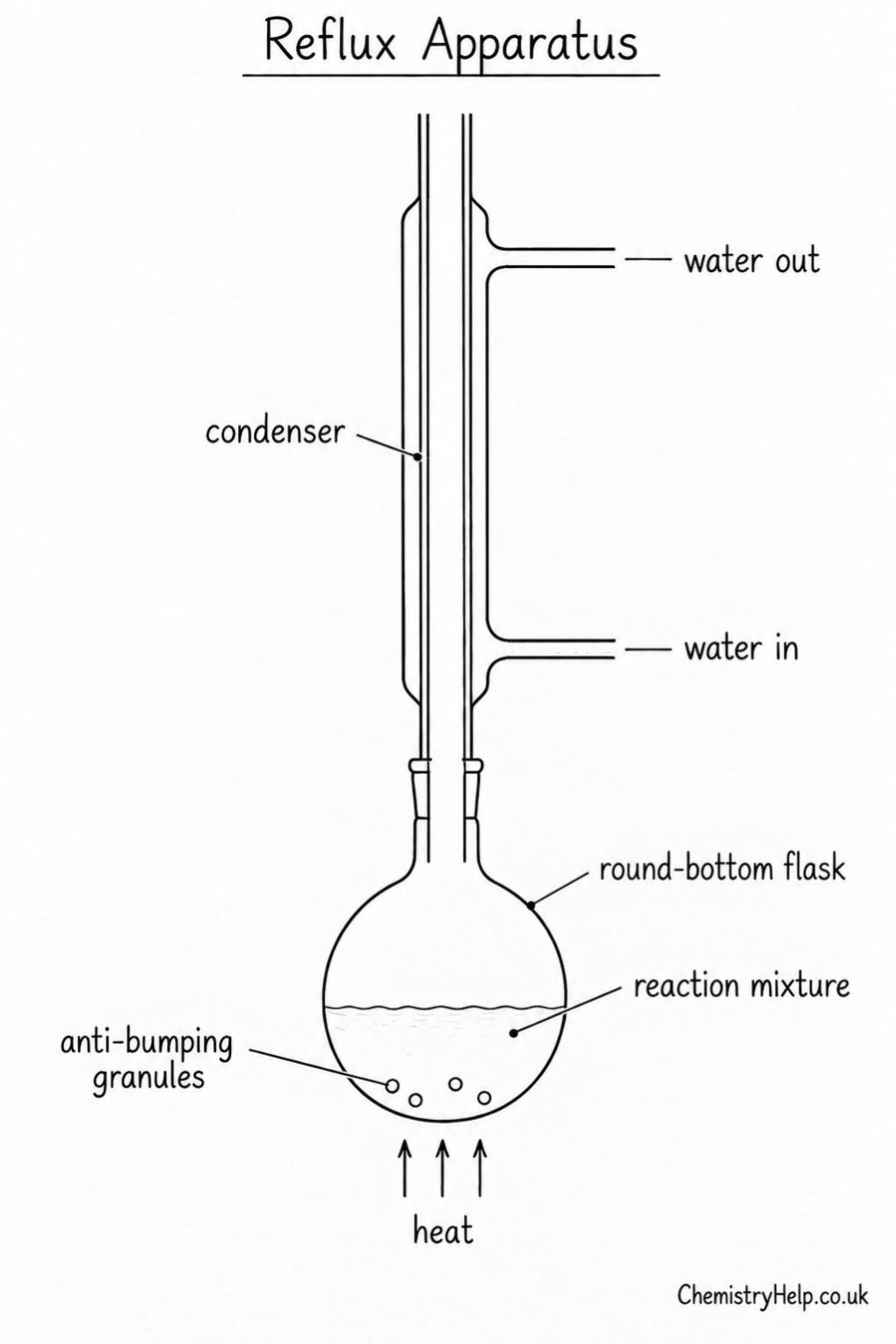
Use distillation when you want to remove a volatile product as it forms; use reflux when you want to keep volatile reactants/products in the flask while heating for an extended time.
My practical check is simple: distil if you want to remove the aldehyde as it forms; reflux with excess oxidant if you want the primary alcohol to continue to the carboxylic acid. The apparatus is controlling how long the product remains exposed to oxidation conditions.
3.3.5.2 Use Fehling's solution and Tollens' reagent to distinguish aldehydes from ketones and state the observations. Quick revision
Fehling’s solution and Tollens’ reagent distinguish aldehydes from ketones because aldehydes are readily oxidised. Fehling’s gives a brick-red Cu₂O precipitate with an aldehyde; Tollens’ gives a silver mirror. Ketones give no corresponding positive result.
For observations, name what you see: brick-red precipitate for Fehling’s or a silver mirror/deposit for Tollens’. “Colour change” on its own throws away the useful chemistry.
3.3.5.3 Know that acid-catalysed elimination of water from an alcohol can produce an alkene. Quick revision
Dehydrating an alcohol eliminates H₂O and forms an alkene. Check the carbons next to the C–OH carbon because an unsymmetrical alcohol can give more than one alkene.
The overall change creates C=C and removes the elements of water. Keep dehydration distinct from oxidation: the carbon skeleton is retained and no oxidising reagent is involved.
3.3.5.3 Connect alcohol-to-alkene chemistry with making addition polymers from a feedstock not directly obtained as an alkene from crude oil. Quick revision
If the starting material is an alcohol, you can dehydrate it to an alkene and then polymerise that alkene by addition. That gives you a route to a polymer even when the alkene feedstock was not obtained directly from crude oil.
3.3.5.3 Draw the elimination mechanism for dehydration of an alcohol. Quick revision
When you draw the acid-catalysed dehydration mechanism, make the leaving group possible first by protonating the OH group. Then show the electron movement that forms C=C and regenerates the acid catalyst.
Every full curly arrow must begin at a bond or lone pair. The mechanism must account for both loss of water and formation of the alkene π bond.